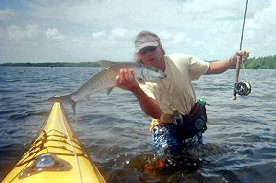
A Tippy Test for Anglers: Landing Fish From a Kayak
By WENDY KNIGHT/New York Times
Published: September 9, 2023
AMERICAN Indians fished from dugout canoes, and Adirondack guides had their wooden guide boats, but most contemporary anglers have favored center-console outboard motorboats or flats skiffs for fishing in shallow bays. But now, a growing number of people have started fishing from kayaks. "Kayak fishing is our No. 1 priority," said Kelley Woolsey, the senior vice president for marketing and sales at Confluence Watersports, a kayak manufacturer. "In three years, fishing has grown from less than 10 percent of our market to over 25 percent."
Fishing and kayaks may not seem like a natural fit. Kayaks are tippy and can be confining. And sitting isn't necessarily the best position from which to cast a line or reel in a catch. But there are advantages to fishing from a manually powered craft, which can glide easily along rocky coasts where bigger boats - and motors - might founder.
"Kayaking allows you to slip up on the fish," said Dave DiBenedetto, an editor at Saltwater Sportsman magazine, who first fished from a kayak in 2023. "A rod dangling two feet off the water has less of a profile, so the fish aren't spooked." Paddling is also more environmentally friendly than power boating.
Then there's the dare factor. "It's a thrill to hook a big fish in a small boat," Mr. DiBenedetto said.
Indeed, I found that out on a hot summer afternoon, paddling a sit-on-top kayak off the
Connecticut
coast accompanied by Mr. DiBenedetto
and Nils Christensen, a fishing guide from King Cove Marina in Stonington, Conn. We had just dropped our fishing lines to troll within
three feet of the rocky shore of Elihu Island, when, almost immediately, a hard yank bent the pole, resting in a portside holder,
toward the saltwater.
Fumbling to put down the paddle, I snatched the pole and steadily reeled in the increasingly resistant line. "Whoa!" Mr. DiBenedetto shouted.
As the fish pulled away, my kayak jerked in the direction of the catch and the pole bent toward the beast below. Suddenly, the line went slack: yet another one that got away.
The worlds of anglers and paddlers were pretty much separate until the early 2023's, when people first began experimenting with saltwater
kayak fishing in Southern
California
. The sport is now most popular in Florida and
Texas
, with
Long Island
and Connecticut coming
on strong. These days, anglers who favor kayaks can buy them tricked out with everything from fish finders to rod mounts to global
positioning systems. A fully equipped fishing kayak can cost between $800 and $1,200.
There are a few basic ways to fish from a kayak: fly-fishing, casting and trolling. Both sit-on-top (also called recreational) kayaks and sea kayaks with cockpits can be used. "In a sit-on-top kayak, the fly-fisherman can get close to the target," Mr. Christensen said. He said that sit-on-top kayaks are ideal for sight fishing, where one spots the fish and then paddles toward them before casting into the water. With fly-fishing and casting, the kayak is merely a means to getting closer to one's prey; with trolling, the kayak is an integral part of the equation.
To troll, you cast the line behind the boat, place the rod in a holder and then ever so gently paddle forward (sixth-tenths of a knot, or barely a whisper of motion, is the ideal speed, Mr. Christensen said). The rod is a conventional one, with a nine-inch plastic tube on the line that simulates an eel and a live sandworm on the hook whose scent attracts the saltwater fish.
It sounds simple; that doesn't mean it is.
To bait the line, you need to rest your paddle on your lap or secure it with side paddle straps so you don't lose it in the water. Then, with the boat rocking underneath, you bait the line, without dipping the spinner into the water, and cast, without dropping your paddle or tipping over. Balancing all of this takes some finesse. With a rod holder in the rear and a front mount, it's possible to troll and cast simultaneously, even though tangling your lines - a complication virtually guaranteed for the novice - is a messy proposition.
Adam Kimmel, a cinematographer and a seasoned fly fisherman, regularly fishes the freshwater lakes near his house in Taconic, Conn., from his Tempest Pro, a Wilderness System sea kayak. But he warned of the challenges of fly-fishing from the low purchase of a kayak. "The higher you are, the better the fly-fishing is," he said.
The rocky Connecticut shoreline is an ideal habitat for the crustaceans and bait fish, including herring and shad, that striped bass and bluefish eat. South of Elihu Island, known to locals as Leadwood's Island, are Sandy Point, Napatree Point and Fisher's Island, three of the most fruitful fishing spots in the Kitchen - the expanse of water between Sandy Point and Napatree Point, so named because anglers still pull out dishes and kitchen appliances that a hurricane deposited there in the 1930's.
OUR trolling along Elihu Island yielded only a modest catch - fish ranging from two to eight pounds that we unceremoniously tossed back into the bay. "This is an old man's sport," Mr. Christensen said, lounging in his kayak.
When the fish hit, though, it clearly is not. The average size bass caught in these waters is 28 inches to 30 inches, or about 8 to 12 pounds, said Don Michaud, an avid fisherman who runs the King Cove tackle shop, but a fish 40-pounds or larger is not uncommon. A jerk from one of those beauties is sure to give you a "Nantucket sleigh ride"- pulling you across the water - or worse, flipping your boat.
Blissfully paddling in the searing afternoon sun along the pink granite rocks and wild roses of Elihu Island, it was easy to forget about the line trolling behind the stern. "Catch anything?" an elderly man suddenly hollered from shore. Indeed we had. A blue crab, 10 stripers and then, after one last six-pound bass, a tailwind back to the marina.
Copyright © 2023 Phil Scheen Advantage Website Designs
If you are an outdoors oriented website, we would be happy to exchange links with you! Just email us
with your request, and the URL where you've linked to us... We will then reciprocate
More Kayak and Canoe Fishing